Businesses hit a wall fast when they try to explain complex products to people who don’t have the time or patience to sit through long explanations. That’s exactly where 2D animation services start carrying real weight.
Video already drives digital spaces, and the 2024 Video Marketing Report shows 93% of marketers saying it helps users understand products faster.
Animation pushes that impact even harder. It cuts through big, tangled ideas and turns them into steps you can grasp in seconds. In fast, competitive markets, 2D animation flips confusion into clarity before the audience even knows they needed it.
Why Businesses Need Simpler Communication Today
U.S. businesses are fighting to get a single clear moment in front of customers who feel blasted from every direction. Products, ads, messages—they all pile up until it’s hard to tell one thing from another. Even the strongest offer can vanish in that noise before anyone notices it.
It gets worse in fields like AI, fintech, enterprise software, and medical services, where heavy explanations push people away fast. Digital platforms make the pressure sharper because attention spans drop in seconds.
Animaker data shows animated content sticks and gets finished more than plain text or static visuals. All of this makes simple, clear communication feel urgent—and that’s where 2D animation cuts through the noise.
How 2D Animation Breaks Down Complexity
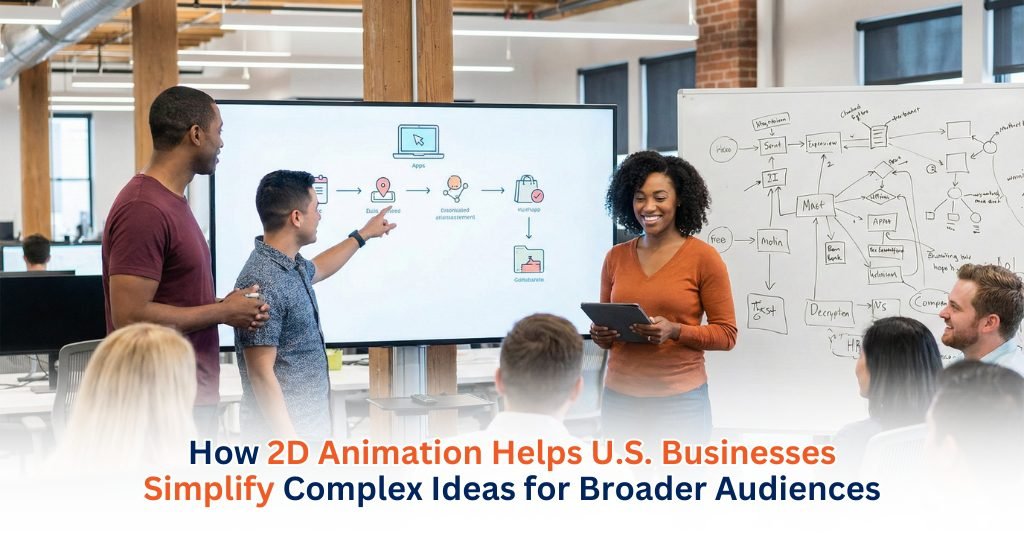
2D animation cuts through complexity before it even has a chance to pile up. It takes multi-step processes, abstract ideas, and technical workflows and turns them into visuals you can follow without getting pulled into long, tiring explanations.
Motion, icons, and simple symbols guide your focus so you see what matters first. Nothing feels chaotic. And because the format keeps you out of heavy jargon, the message lands even for people who don’t have technical expertise. It makes tough ideas feel clear in seconds.
Benefits for U.S. Businesses Using 2D Animation
2D animation gives businesses a practical way to communicate clearly, engage audiences, and present information with more confidence across digital channels.
Faster Audience Understanding
2D animation hits you with clarity before your mind even starts to wander. It strips away long explanations and shows the point in seconds, no dragging, no mental heavy lifting. That’s why it works so well for onboarding, product walkthroughs, and quick explainers—places where confusion can wreck the whole message. People stay engaged, they remember more, and they actually finish the content. When complex ideas move right in front of you with sharp visual cues, the message sticks before you even realize it.
High Engagement Across Digital Platforms
Animated content cuts through U.S. digital platforms with the kind of force you feel right away. Busy feeds, noisy inboxes—it still grabs you. The visual cues hold attention even when the sound is off, which is how most people scroll anyway. It pulls viewers in faster than static posts and keeps them watching longer. That’s why 2D animation works so well for brands that need quick engagement to stay visible.
Cost-Effective Production for Small and Mid-Sized Businesses
Compared with live-action or 3D animation, 2D animation feels almost liberating. Costs fall, but the visuals still land with force. You skip the whole drama of sets, actors, and equipment, and the moment something needs to change, it shifts on screen without slowing you down. The process moves with you, not against you, and that speed hits hard when you’re trying to keep up with constant updates. That kind of flexibility is a relief for teams that update content often or post on a tight schedule. And with quicker production cycles, brands can move fast and keep pace with markets that shift before you even blink.
Consistent Brand Identity
2D animation keeps a brand locked into one clear identity because the colors, type, characters, and style stay the same everywhere. It moves easily between reels, website banners, training videos, and ads, so nothing looks out of place. Consistent visuals make people remember you and trust you faster. With 2D animation, you hold that steady look without rebuilding your assets every time you publish on a new channel.
Where U.S. Businesses Commonly Use 2D Animation
U.S. businesses rely on 2D animation services in many parts of their communication strategy because it adapts easily to both external and internal needs.
- Marketing and advertising rely on this because it grabs you fast. Explainer videos, social posts, paid ads, and landing page animations hit with quick impact and make the brand’s message land before the viewer even thinks twice.
- Customer education hits harder when it’s clear. Tutorials for SaaS tools, financial platforms, and healthcare services walk users through each step so they don’t feel lost. When people understand what to do right away, support requests drop fast and the whole experience feels smoother.
- Employee training hits differently when the visuals do the heavy lifting. Safety modules, compliance steps, and onboarding workflows stop feeling like a maze and start making sense the moment they’re laid out in clear, structured visuals. It lands fast, and people actually get it.
- Investor presentations hit harder when the visuals don’t make people squint and guess. Complex pipelines, product roadmaps, and market projections land faster when they’re broken down with simple, clean animated graphics that show the flow instead of burying it in slides.
- E-commerce Brands lean on 2D animation because it gets the point across fast. It shows product features, assembly steps, or quick comparisons in a way that feels direct and easy to follow, without dragging through heavy production work.
How 2D Animation Improves Communication for Broad or Diverse Audiences
Clear visual storytelling hits you in one go and clears out the noise before you even realize it. That’s why U.S. businesses grab onto it when they need to reach all kinds of people at once. Animated visuals don’t bother about age, language, or how someone learns—they pull you in even when the message feels heavy or way too technical.
Motion cues and simple symbols do the job without drowning viewers in complex terms. That helps people with limited English or low technical comfort stay with the message. And for public-facing brands, this kind of clarity keeps audiences locked in, even when the topic needs real explanation.
Conclusion
Strong communication hits you right in the gut when people don’t have the time or energy to unpack complicated ideas. When you take something dense and break it into clean, sharp visuals, 2D animation steps in like a relief.
It shows the value straight up, no overload, no mental wrestling, just a clear understanding that actually lands. And for teams trying to fix clarity in marketing, training, or product education, this approach delivers real flexibility and real impact.
QA Solvers steps in with structured visual content development and 2D and 3D animation services so brands can share messages that feel steady, clear, and easy to trust.