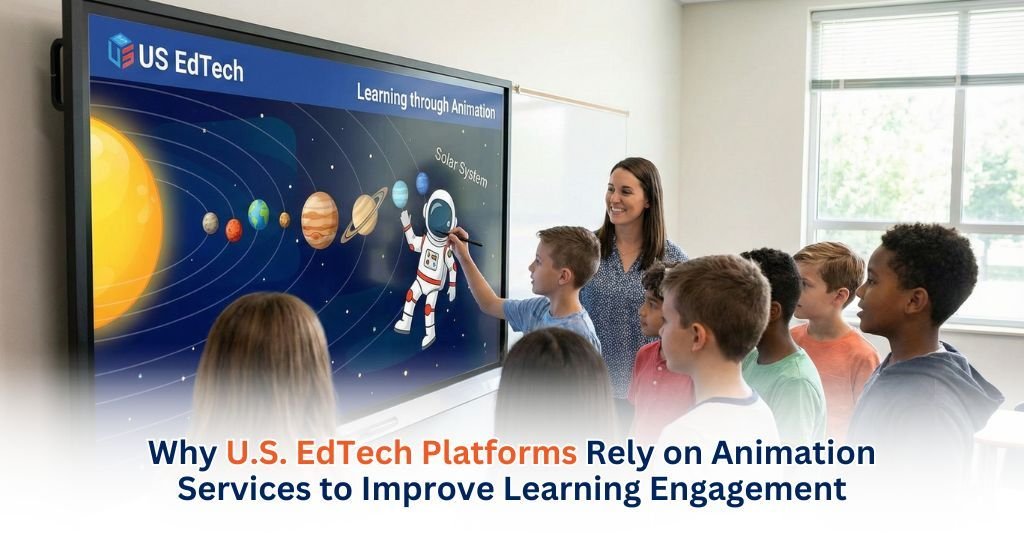
Many U.S. EdTech platforms lean on animation now because it actually cuts through the noise. It helps learners grasp complex ideas without feeling lost or overwhelmed. Studies keep showing the same thing—animation pulls attention in and locks it, something text or long lectures just can’t manage.
And today’s learners want content that moves fast, makes sense, and doesn’t drain their focus. Strong animated lessons take difficult concepts and break them down in a way the mind holds onto.
That’s why animation services keep becoming the go-to move for EdTech teams trying to lift engagement and real learning outcomes.
The Engagement Problem in U.S. Digital Learning
Many U.S. EdTech platforms keep running into the same wall—students tune out fast. When lessons feel passive, text-heavy, or flat, attention slips before the halfway mark. Screen fatigue hits, information piles up, and the mind just checks out.
And today’s learners expect the same sharp, dynamic visuals they see on entertainment platforms, not endless blocks of text. Research on video-based learning makes it obvious: moving visuals pull learners in and keep them there.
That gap is loud and clear—digital education needs content that grips attention, and animation is the thing that finally does it.
How Animation Enhances Clarity and Comprehension
Animation hits the brain in a way plain text never does. It pulls in dual-coding theory without you even noticing—you hear the idea, you see it move, and it sticks. When lessons unfold through motion and steady pacing, students lean in instead of drifting off.
It pushes their learning instinct straight to the surface because the content feels alive, not like some weight sitting on their mind.
Research keeps saying the same thing again and again—animated instruction grabs attention and sticks in memory in a way static slides never manage. And since you can shape animation for visual, auditory, or mixed learners, it meets students exactly where their brains already are.
Why EdTech Platforms Prefer Animation for Engagement
EdTech platforms rely on animation because it delivers engagement at a scale and consistency that text-heavy formats struggle to match.
Consistent Learning Experiences at Scale
Animation locks the message in place so every learner hears the same clear, accurate explanation, no matter when they hit play. No mixed signals. No gaps because one instructor explains it one way and another explains it differently.
Big U.S. K12 districts and higher-ed platforms depend on that level of consistency because thousands of students move through the same material at different speeds. Animation holds the structure steady, which matters even more when a tough subject stretches across grades and campuses.
Supports Microlearning and Modular Learning
Short, targeted lessons sit at the center of EdTech now, and animation slides into that space without effort. Bite-sized modules, app tutorials, and quick refreshers land better when motion pulls the learner through each step.
Because these animated micro lessons feel doable, people actually finish them. And when learners can replay a short clip anytime, it cuts the overload and helps them space their learning through the week without feeling swamped.
Increases Accessibility for Diverse Learners
Animation opens up understanding in a way text alone just can’t. When you put motion, clear visuals, and direct cues in front of students who struggle with heavy reading, ESL learners, or anyone who loses focus fast, the content finally lands. Visual flow keeps their attention steady.
Captions, multilingual voiceovers, and simple graphics give them room to breathe instead of pushing them into overload. This kind of flexibility helps EdTech platforms reach a wider U.S. learner base without leaving anyone behind.
Makes Gamification and Interactive Learning More Effective
Animation lifts gamified learning because it slips right into the flow of rewards, characters, stories, and challenges without feeling forced. It keeps students locked in during quizzes, puzzles, and practice tasks.
Most early childhood and K12 apps in the U.S. lean on animated characters to introduce ideas, show behaviors, and lead students through each step. And because animation sparks emotion and curiosity fast, these interactive lessons stick. Students stay involved, remember more, and push themselves further.
Real Use Cases in U.S. EdTech Platforms
Animation shows up across many U.S. EdTech platforms because it makes instruction clearer, more engaging, and easier to follow for different types of learners.
- K–12 learning apps use animated science explainers, math tutorials, and reading lessons because kids understand faster when the idea plays out like a simple story they can follow.
- Higher education platforms use animations to break down biology, physics, coding, and engineering topics so students can see each step instead of getting lost in dense text.
- Corporate and workforce tools rely on animated simulations for compliance, software demos, and safety training because people learn procedures better when they watch them unfold.
- Special education tools use steady, predictable animated visuals that help learners with ADHD, autism, or processing challenges focus without overload.
- Test prep platforms use animation to walk students through formulas, reasoning steps, and strategies so exam concepts click faster.
Why EdTech Providers Choose Professional Animation Services
EdTech providers turn to professional animation because they need accuracy that doesn’t slip for even a second. With 3D animation services, studios sit with subject matter experts during scripts and storyboards so nothing breaks academic flow or bends facts. The final output feels solid, which boosts how learners and institutions trust the brand.
Outsourcing saves teams from sinking time and money into building an in-house setup. It also gives them ready access to 2D, 3D, and interactive modules; whiteboard explainers; and app-ready videos, making it easier to scale across any learning space.
Implementation Considerations for EdTech Teams
EdTech teams can’t just toss animation into a platform and hope it works. It needs to lock in with curriculum standards and learning outcomes, or the whole thing feels off.
Most students are on their phones anyway, so every animation has to survive the small-screen reality without losing clarity. And accessibility isn’t some side note—captions, contrast, audio descriptions, all of it keeps learners from slipping through the cracks.
Teams also have to know when they need something sharp and custom from 3D and 2D animation services and when a simple template will do the job. Version control becomes that quiet lifesaver when standards shift and content starts aging fast.
And if no one is tracking watch time, engagement, quiz scores, and real learning outcomes, then you’re basically guessing what works instead of seeing it happen.
Conclusion
Strong learning experiences hit only when the content is clear and actually holds a student’s attention. Animation steps in and takes those heavy, confusing topics and makes them feel manageable, even simple.
When that happens, students stay in it, finish more lessons, and move with real confidence. And with digital education growing fast, picking the right animation partner isn’t a small decision anymore.
QA Solvers covers that need with professional video animation services built for structured learning. With one of the best video animation services behind them, EdTech teams can create lessons that feel direct, sharp, and easy for every learner to absorb.