Small manufacturing businesses are running into a skills gap that keeps getting wider, and equipment training is where the pressure shows first. The numbers are blunt. The gap is not theoretical.
The Manufacturing Institute estimates that up to 2.1 million U.S. manufacturing jobs could stay unfilled by 2030 because skilled workers are hard to find. That shortage hits training first. Building in-house expertise for modern machinery becomes a constant struggle, even when production timelines leave no room to wait.
In that environment, manuals and shadowing stop working. They struggle to explain complex procedures safely and consistently. This is where professional 3D video animation services step in. They translate real equipment workflows into clear visual guidance, helping teams learn faster, reduce risk, and train with consistency instead of guesswork.
The Limits of Traditional Equipment Training Methods
Printed manuals tell you what a part is and what a procedure looks like on paper. They completely fail the moment motion enters the picture. No sequencing. No internal interaction. Operators have to stare at static diagrams and mentally convert them into real actions on complex machines. That mental jump is risky, and everyone knows it.
On-site demos depend on who is available, how much experience they bring, and how much pressure production is under to keep moving. When downtime feels expensive, supervisors speed through training, and critical steps quietly drop out of the process. The problem is not effort. It is compression.
Shadow training also shifts with the shift itself. Each operator explains the process through their own habits, so knowledge quality changes across teams and hours. New operators often learn directly on active machinery rather than in controlled settings, where errors can be isolated and corrected without real consequences.
When training breaks down, it doesn’t fail quietly. Equipment gets damaged. Production slows or stops. Safety rules get violated. Workers get hurt. Each mistake stacks onto the next. Small manufacturers don’t have spare margin for that kind of fallout. One breakdown is enough to disrupt schedules, strain budgets, and put real pressure on the operation.
Why Equipment Complexity Demands Visual Simulation
Modern manufacturing systems pack automation, sensors, robotics, PLCs, and software into tight, enclosed assemblies. Most of the real action happens where operators cannot see it during live operation. That’s the gap. Traditional instruction talks around internal motion paths and system dependencies instead of showing them, leaving operators to guess how systems behave inside the machine.
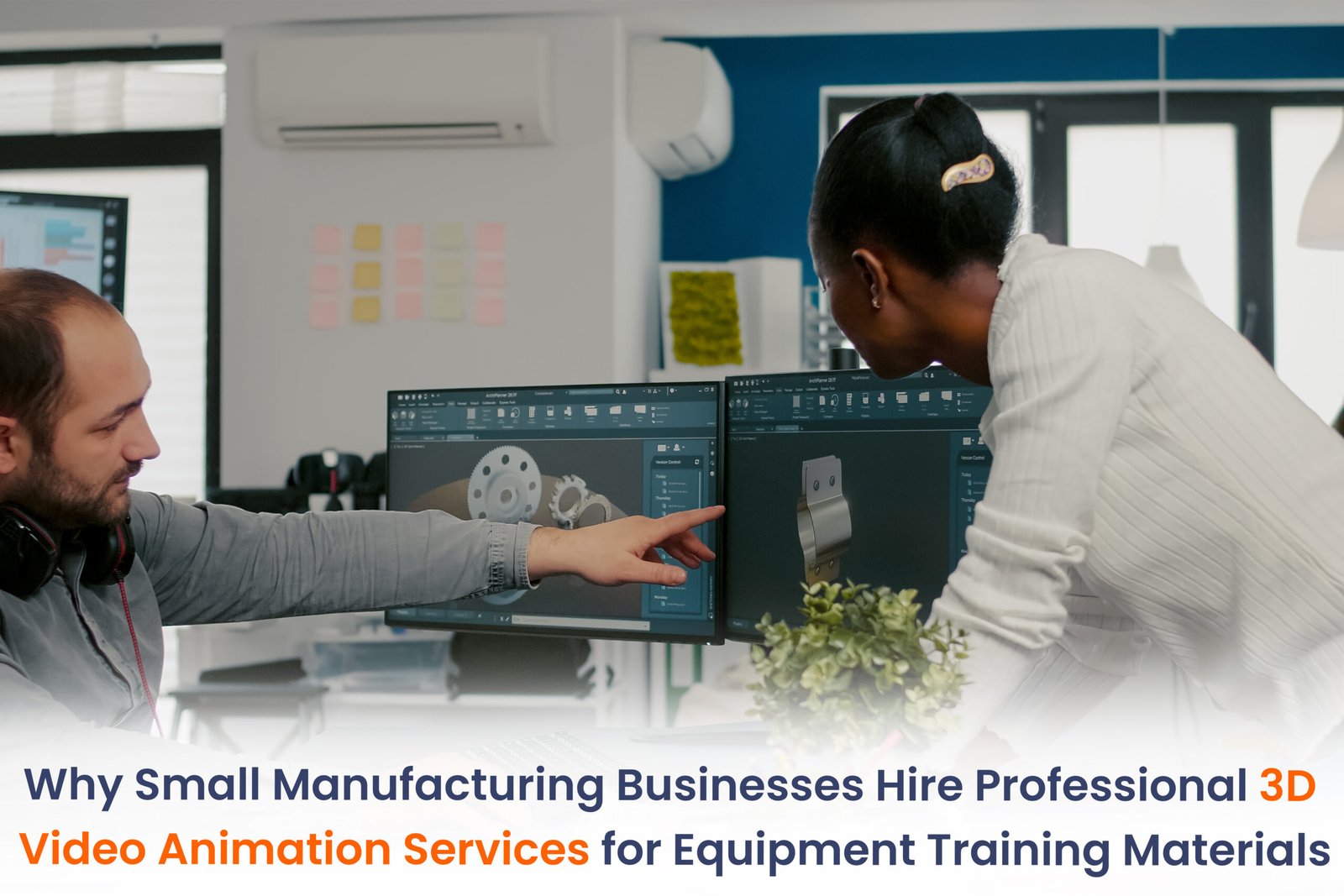
Three-dimensional animation closes that gap. Exploded views, sectional cutaways, and step-by-step sequencing reveal what normally stays hidden. Assembly and disassembly stop feeling uncertain. Calibration steps become clear. Safety lockout-tagout procedures and preventive maintenance workflows follow a visible, logical flow.
When operators see each action connect to a mechanical response, cause and effect finally click. That clarity builds confidence, reduces hesitation, and supports skill retention over time.
Cost Efficiency for Small Manufacturers
Small manufacturers run on thin margins and lean teams. Every new hire puts pressure on payroll, schedules, and supervision. Full-time trainers add cost that never really stops. Professionally produced 3D training modules change that equation. Once built, they work as reusable digital assets. Teams can run them across shifts without adding instructor hours.
Visual modules also cut machine downtime during onboarding. Trainees learn core procedures before they ever touch the equipment. That speeds time-to-productivity and protects output targets. Standardized training reduces procedural errors that trigger rework or retraining. Fewer mistakes mean less material waste, less equipment misuse, and fewer service calls. The return on investment stays visible and measurable.
Safer Induction and Compliance Training
High-risk machinery leaves no room for loose instruction. Safety training has to follow regulatory standards, not good intentions. The Occupational Safety and Health Administration already mandates training for equipment operation and hazard communication across many industrial settings. That requirement sets the baseline, not the finish line.
Three-dimensional animation makes those rules visible. Hazard zones, emergency stop actions, PPE use, and startup and shutdown sequences stop being abstract steps and start looking real. Trainees see risk without facing it. That matters. It reinforces lockout-tagout protocols and safe work practices before anyone touches live equipment.
Digital training modules also create a paper trail. They support compliance records, reduce liability exposure, and show due diligence when inspections or audits hit.
Supporting Multi-Shift and Multi-Location Operations
Small manufacturers often run rotating shifts just to keep production on pace. That’s where training starts to crack. Quality changes with supervisor availability, mood, and method. Structured 3D video modules flatten that problem. Every operator sees the same step-by-step process, no matter the shift. Day crews and night crews train off the same material, without depending on one person to explain it right.
Contract and temporary workers get standardized instruction before they touch equipment. Digital modules also plug into existing LMS setups, which most teams already use for tracking and records. That structure supports remote onboarding for satellite sites while keeping operational procedures consistent across locations.
Easier Updates for Equipment Modifications
Manufacturing equipment does not stay fixed. Upgrades, retrofits, and configuration changes happen to push performance or meet new requirements. The moment that happens, printed manuals fall behind. They need revision, reprinting, and redistribution, and version control starts to slip.
Digital 3D training modules change that dynamic. Teams can update specific components, motion sequences, or safety steps without tearing down the entire program. Updates stay controlled and traceable.
Engineering teams align revised CAD data with training visuals, while operations and maintenance teams receive the same instructions at the same time. That alignment cuts confusion, blocks outdated procedures from circulating, and keeps execution consistent across the production floor.
Competitive Advantage in Workforce Development
Skilled labor shortages hit small manufacturers hard. They compete with larger firms for trained operators and usually lose that race. Industry reports from The Manufacturing Institute keep pointing to the same issue — manufacturing still faces workforce shortages. That pressure lands on the shop floor.
Structured visual training changes the pace. When equipment processes appear in a controlled, repeatable format, skill development speeds up. Operators move from watching to doing with more control. Confidence rises during the shift from training to live production.
It also strengthens apprenticeship tracks and technical onboarding because the training aligns with documented procedures. When companies invest in digital training assets, they signal discipline. Clients, partners, and auditors see workforce readiness backed by process, not guesswork.
What Small Manufacturers Should Look for in Professional 3D Video Animation Services
Technical competence should come first when selecting a 3D animation partner. Industrial workflows, mechanical sequencing, and shop-floor constraints must be understood, not guessed. If the team cannot interpret CAD files and engineering drawings, visual accuracy collapses fast. Motion simulation should mirror real equipment behavior, not simplified movement that looks smooth but teaches the wrong process.
Manufacturing safety knowledge matters just as much, including OSHA-aligned procedures where applicable. A modular production approach allows updates without rebuilding everything. Scripts need to align with operational SOPs and maintenance documentation, not sit beside them. The service should also integrate with learning management systems or internal training platforms, so deployment stays controlled and performance tracking remains possible.
Conclusion
Small manufacturing businesses cannot afford shaky instruction when equipment precision and worker safety sit on the line. One mistake costs time, output, or someone’s health. Structured visual training lowers that risk. It protects production targets and gets workers ready before problems show up.
Professional 3D video animation services break complex machine workflows into repeatable digital assets. They support onboarding, compliance, and skill transfer. QA Solvers delivers animation aligned with engineering documentation and safety standards.
This shifts training from reactive fixes to controlled knowledge management. Manufacturers gain stability, clarity, and room to scale without losing operational control.