Let’s be honest. In today’s fast-paced workplace, HR and L&D teams are fighting a battle they should not have to fight-low engagement and weak information retention during process and policy training. You can build a culture of compliance, you can design structured programs, but if people are mentally checked out, none of it lands.
The data is blunt. Only 10% of employees call compliance training “excellent,” yet 95% of organizations insist they prioritize a culture of compliance. Let that sink in. There is a massive disconnect. And then there’s this: 92% of workers say effective training directly impacts their job engagement. The message is clear. People are not rejecting training. They are rejecting training that fails them. That gap is not small. It is glaring.
And that is exactly why visual learning approaches like whiteboard animation are gaining serious attention.
The Engagement Gap in Process and Policy Training
Here is the uncomfortable truth: traditional process and policy training feels dry, mechanical, and painfully technical. Employees sit in front of text-heavy manuals and lifeless slide decks, and you can almost watch their attention fade in real time. Their eyes are open, but their minds are gone.
Many employees consider conventional formats less motivating, which directly affects attention and recall. And yet, 92% of employees believe well-planned training improves engagement. That tells us something critical. The issue is not training itself. The issue is delivery.
Animation research, including whiteboard animation formats, reports higher engagement and enjoyment compared to text-only or audio-only instruction. That is not a coincidence. When delivery changes, attention changes. And when attention changes, learning finally has a chance.
Turning Complex Policies into Simple Visual Stories
Policies are often dense. They are layered with conditions, clauses, and structured language that can overwhelm even attentive learners. This is where whiteboard animation shifts the dynamic.
Cognitive science does not whisper this—it states it plainly. When visuals are combined with narration, cognitive load decreases, and learners process complex information more efficiently than when they face text alone. The brain is not meant to wrestle with walls of words.
Mayer’s multimedia learning theory makes it even clearer: people understand material better when meaningful graphics work alongside verbal explanations. When we see it and hear it together, comprehension strengthens. It stops being abstract. It becomes real.
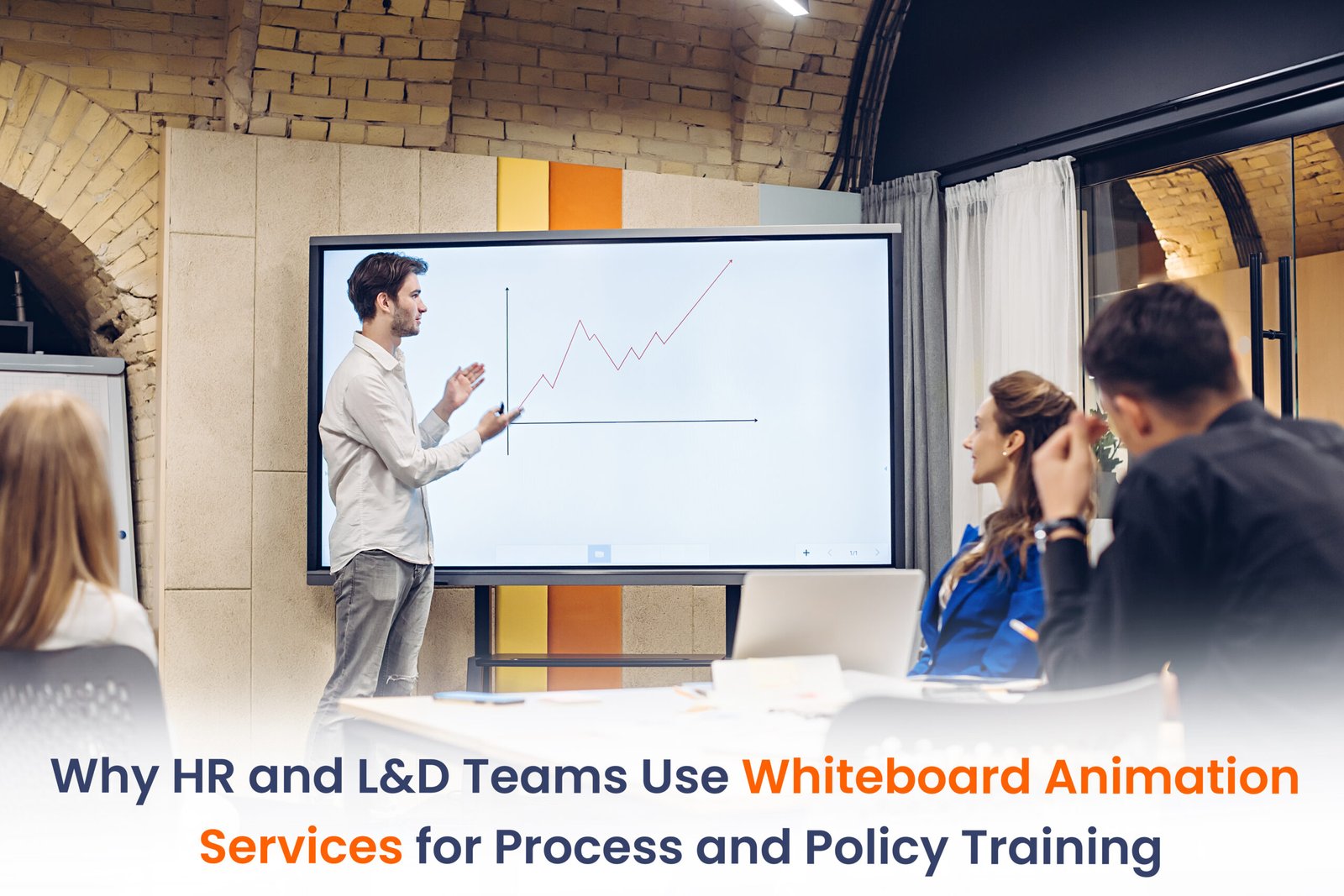
Now think about codes of conduct, safety procedures, or compliance requirements. These are not abstract ideas. They are actions, decisions, and consequences. When visual sequences illustrate steps, flows, or outcomes, learners do not just read the policy—they see how it operates.
Whiteboard-style animation makes the logic visible. It transforms structure into story. And suddenly, what felt heavy becomes understandable without losing accuracy.
Improving Knowledge Retention and Recall
Understanding something in the moment is easy. Nodding along during training is easy. But remembering it when a real decision is on the line-that is where the difference shows.
Educational psychology does not leave this to guesswork. Pairing visuals with narration strengthens learning. Dual coding theory explains why when information is presented both visually and verbally, the brain encodes it through two cognitive channels instead of one. Two pathways. Stronger retention. A far better chance that the knowledge stays when it is actually needed. Multimedia learning research reinforces this principle.
Then there is structure. Short, focused training segments—similar to microlearning—have been associated with stronger retention compared to longer, text-heavy modules.
When you apply these principles to process and policy training, the result is clear. Visual formats like whiteboard animation are not just more engaging. They support recall. And in compliance training, recall is everything.
Standardizing Process Training Across Locations and Teams
Another reality HR and L&D teams face is inconsistency. Different facilitators. Different interpretations. Different explanations. The message shifts—even slightly—and that shift does not stay small. It spreads. It compounds across departments until the original intent barely resembles what people actually understand.
Research on workplace learning makes this clear: consistent instructional materials reduce variability in understanding and performance outcomes. Video-based training, including animations, locks in that consistency because every learner receives the exact same narrated and visual content. No improvisation. No dilution.
For geographically distributed workforces and remote employees, that consistency is not optional. It is critical. A standardized multimedia format supports scalable onboarding and compliance training while minimizing interpretation gaps that can quietly turn into real risk.
When the message stays stable, clarity improves. And clarity protects organizations.
Making Compliance Training Less Intimidating
Compliance training has a reputation—and not a good one. It feels like an obligation hanging over your head. Something to get through. Something to survive. Not something to truly understand. Employees click. Scroll. Sit there. Endure it. The text-heavy manuals and endless lectures only make it worse. Policies start to feel distant, rigid, almost suffocating.
But organizations are no longer ignoring that reaction.
They are shifting toward engaging, interactive approaches—visual storytelling, real-world scenarios, structured multimedia—because research shows interactive content sustains interest and motivation.
When policies are shown through relatable examples and clear visual narratives, something changes. Employees see themselves in the situation. The message stops feeling abstract. The tension drops.
Compliance does not have to feel oppressive to be taken seriously.
Cost-Effective and Scalable for Ongoing Policy Updates
Training is not a one-time event. It does not end after a single session. Policies evolve. Regulations change. Processes adapt. And every change demands clarity.
Video-based formats—including animated and whiteboard-style content—are recognized for being cost-effective and scalable. Once developed, animated videos do not require repeated trainer hours, travel arrangements, or facility scheduling. They can be deployed across departments and locations with the same structure and message intact.
That scalability is not just efficient. It gives organizations the ability to respond to policy updates without rebuilding training from the ground up every time a change happens. Over time, that reduces overall training expenditure.
Updating content can also be more efficient than revising instructor-led programs or printed materials. Specific sections can be modified without rebuilding entire courses.
For ongoing compliance updates, onboarding, and repeated policy communication, that flexibility becomes practical, not just convenient.
Supporting Inclusive Learning with Multimodal Formats
Training is not a one-time event. It does not politely conclude after a single session. Policies evolve. Regulations tighten. Processes shift. And every shift demands absolute clarity.
Video-based formats—including animated and whiteboard-style content—are recognized for being cost-effective and scalable. Once created, animated videos do not drain additional trainer hours, travel budgets, or facility resources. They move across departments and locations carrying the exact same structure and message every time.
That scalability is more than operational efficiency. It gives organizations the power to respond to policy updates without tearing everything down and starting over whenever change inevitably arrives.
While research questions rigid “learning style” categories, evidence supports the value of presenting information through multiple channels. In workplace training, that means more employees can process, understand, and apply policy content effectively.
Inclusion is not just about access. It is about clarity.
Conclusion
Policy and process training cannot rely on hope that people will “figure it out later.” As regulations change and workflows evolve, organizations need training that stays clear, consistent, and scalable.
This is where whiteboard animation services deliver real value. They replace passive acknowledgment with visible understanding and repeatable learning.
QA Solvers supports HR and L&D teams through whiteboard animation, explainer video development, and training-focused visual content built for compliance and internal communication.
These services help organizations update policies with precision, maintain consistency across teams, and reduce training friction. When employees understand policies in context, compliance improves, risk drops, and training finally does what it is meant to do.