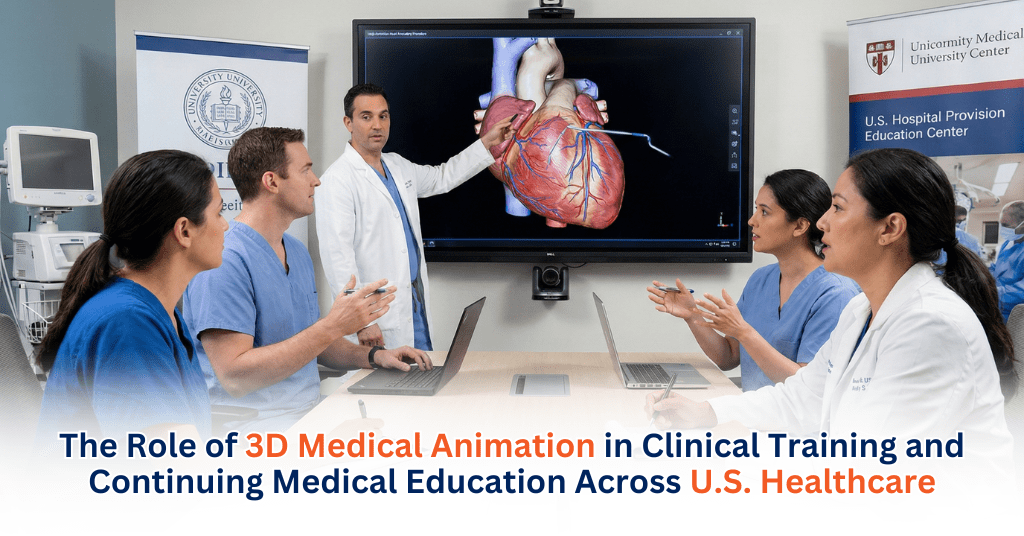
3D medical animation is slipping into U.S. clinical training because everything in healthcare keeps getting more complex. Clinicians need a way to see what they’re learning, not fight through dense explanations, and visual learning hits that need fast.
A 2023 scoping review of 23 studies on PMC even showed how students and educators lean toward 3D video because it actually helps them learn.
That’s why 3D animation services now sit at the center of clinical training and continuing medical education. They speed up learning, cut the guesswork, and help skills stick when it matters.
Why Modern Clinical Training Requires Visual Precision
Clinical training in the U.S. is getting tougher by the day. Clinicians deal with advanced devices, new therapies, and minimally invasive procedures that leave zero room for guesswork. And the old training setup struggles to keep up. Cadavers are limited, instructors explain complex steps in different ways, and clinical rotations move so fast that learners barely get time to breathe.
Studies on PMC and NIH-backed research keep saying the same thing—simulation, visualization, and multimedia sharpen understanding and improve procedural accuracy. That push toward clearer learning tools is real.
Teams want explanations that don’t shift from one instructor to another. They want consistency they can rely on. That’s why animated medical content is turning into a must-have support in modern clinical training, not some optional extra.
What 3D Medical Animation Brings to Clinical Training
3D medical animation adds depth and clarity to clinical education by giving learners accurate visuals, structured walkthroughs, and a safe space to develop essential skills.
Detailed Visualization of Anatomy and Physiology
High-quality 3D medical animation lands with a clarity that stops you for a moment. Textbooks and models don’t even come close. You see organs, tissues, and cells move in ways that make the whole system click in your head. And when a disease process unfolds right in front of you, it hits with a force that’s impossible to ignore. It tightens their base understanding, no matter where they are in their training.
These visuals go places where live demos can’t. Cross-sections, zoom-throughs, stacked layers—you see everything without guessing. That level of detail pulls the whole picture together and keeps learners steady when they step into complex, fast clinical programs.
Step-by-Step Simulation of Procedures
Animated simulations lay out a procedure in a way that hits you right away. Each step is clean, direct, and easy to follow. You watch the technique, the timing, the reasoning—everything—unfold without the usual fog.
When you see a catheter placement, a diagnostic path, an endoscopic move, or an emergency response play out, the precision feels almost confrontational because you can’t miss how the tools and tissues react to each other.
This hits even harder in cardiology, orthopedics, oncology, and trauma care—because one tiny slip can shake the whole outcome in a way that makes your stomach drop. And when the full sequence sits right in front of you, the insight hits fast, almost jolting, long before you even go near a real case.
Safe, Repeatable Practice Environment
3D animation gives learners a controlled space where nothing feels rushed and no one is at risk. They can replay a procedure again and again until it actually sticks. That freedom builds a kind of steady confidence before they even step into a skills lab or a simulation room.
It also gets them ready for those tough, rare scenarios that never show up when you expect them to. When they can loop the same moment with sharp, detailed visuals, the whole picture sinks in. They start to see what’s coming and how they need to move. So when the real thing finally hits, it doesn’t slam into them out of nowhere—they’re already steady on their feet.
Benefits of 3D Animation for Continuing Medical Education
Clinicians need updates they can grasp fast, not sift through. 3D medical animation lays out new tools and guidelines in a clear, direct way that keeps continuing education sharp and current.
Keeps Clinicians Updated on Advancing Medical Technologies
Ongoing medical advances hit fast, and clinicians have to keep up with new devices, surgical robotics, biologics, and shifting diagnostic tools. Animated visuals make that jump easier because they show how these technologies work and how they slide into updated treatment plans without leaving anyone guessing.
They also help teams stay aligned with new FDA guidance and changing clinical standards. Doctors can see what changed, why it changed, and how it affects real practice. That clarity makes it easier to adapt as the U.S. healthcare field keeps moving.
Supports Consistent, Standardized Learning Across Teams
CME programs can feel uneven because every instructor explains things their own way. That gap shows up fast when the topic is complex. 3D animation cuts that problem right at the root. Everyone sees the same clear, accurate breakdown, no matter who’s teaching.
Large hospital networks and multi-site teams feel the impact even more. When every location gets the same training, communication stops slipping. Misunderstandings drop. People follow the same protocols without second-guessing who taught what. It keeps the whole system steady.
Improves Knowledge Retention and Long-Term Competency
Research on platforms like PMC makes one thing clear—multimedia hits the brain harder than plain text. Animated learning sticks. It stays in your head long after you close the screen. For CME, that means clinicians hold on to the details and can circle back to tricky concepts without feeling lost.
Animated modules also keep you alert, even when the topic is dense. You can jump in during a tight schedule and still walk away with something solid. Over time, that steady reinforcement builds real competency and helps clinicians fold new skills and updated knowledge into their daily work without hesitation.
Real-World Applications in U.S. Healthcare Settings
3D medical animation plays a direct role in many U.S. healthcare settings, supporting training needs that range from foundational learning to advanced clinical decision-making.
- Medical schools and universities use animated lessons because they make anatomy, physiology, pathology, and early clinical ideas hit straight without confusion. Students can replay the visuals until every step makes sense.
- Residency and fellowship programs use animations to walk through advanced surgical workflows, emergency moves, and specialty procedures that depend on exact timing. It gives trainees a clear run-through before they step into the real thing.
- Hospitals and integrated health systems use animations because they cut straight through the noise. They help nurses, physicians, technicians, and allied health staff learn the same steps without anyone fumbling through unclear instructions.
- Medical device and biotech teams use animated demos to show how a device works, how it should be placed, and what safety rules can’t be ignored. It gives clinicians a clear picture before they even step into the procedure room.
- Pharma teams plug mechanism-of-action animations into clinician training so complex drug behavior becomes something you can grasp in seconds.
- Public health groups include animations in CME materials to make vaccination rules, prevention steps, and outbreak response easier to absorb under pressure.
How 3D Animation Enhances Skill Development and Decision-Making
A clearer learning path shows up the moment clinicians can see how a disease builds and how a procedure actually plays out. When those timelines move in front of you, diagnostic reasoning hits harder because the patterns stop hiding behind long blocks of text.
Accurate animated sequences also lock into procedural memory. They make it easier to recall each step when you’re standing in a real clinical moment. And when the visuals spell out complications, technique shifts, and alternate routes, you walk in with a wider sense of what could happen.
When nurses, techs, and physicians train with the same reference, everyone moves in sync. That shared clarity steadies the team during high-stakes procedures. It gives you room to rehearse in your head, breathe, and step in without that edge of uncertainty.
Implementation Considerations for U.S. Healthcare Organizations
Implementing 3D medical animation in clinical training needs slow, careful thinking. Every visual detail has to be checked by subject matter experts and clinicians so nothing drifts from current medical standards.
When these animations pull data from EHR systems or use patient-specific details, the workflow has to be HIPAA-safe. No gaps. No loose ends. Teams then decide where to invest—custom animations for tough, high-risk procedures or ready-made libraries for routine topics.
The delivery formats shift from LMS platforms to simulation labs, mobile apps, VR or AR modules, and even training kiosks inside hospitals. Version control becomes a must because guidelines change fast, and device updates never stop. With solid budgeting, the same animations can support both CME and staff training without teams rebuilding everything from scratch.
Conclusion
Stronger clinical training hinges on tools that actually make sense the moment you see them. When the visuals are clear, clinicians learn new techniques without feeling lost, keep up with changing standards, and stay steady in high-pressure moments that usually shake confidence.
U.S. healthcare is moving toward nonstop learning, and 3D animation is slipping right into the center of that shift. QA Solvers backs this push with its 3D animation services in USA, giving teams training materials that land fast and stay in the mind.
With the right visuals in place, healthcare teams can make sharper choices about how they teach, how they learn, and how they lift patient care.