Many education programs still deal with tests that don’t match what students are actually learning, and it shows.
When assessments miss the mark, teaching wobbles, measurement feels off, and student progress gets blurred. Research keeps saying the same thing—when assessments align tightly with learning objectives, everything steadies.
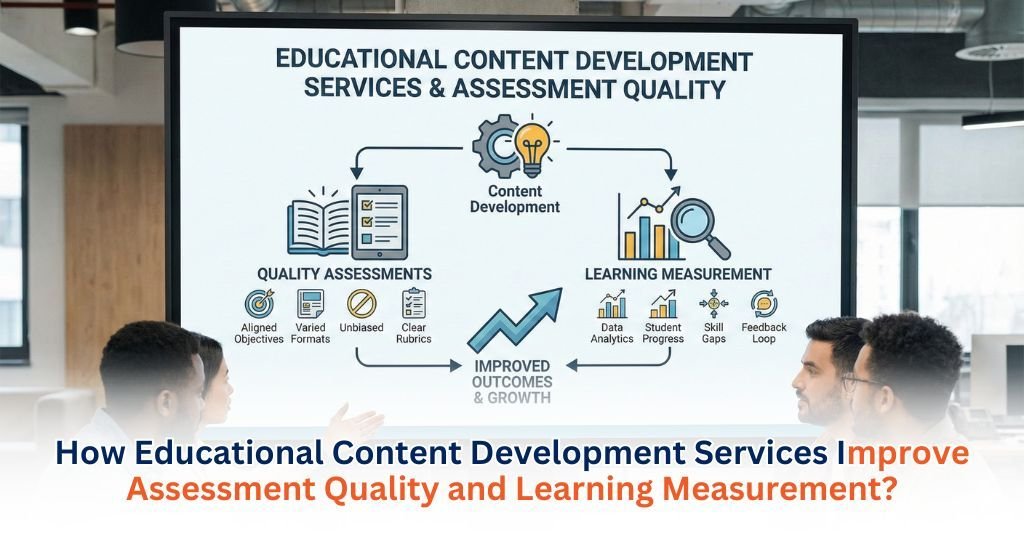
Educational content development services step in here. They build assessments through constructive alignment and expert validation, so educators can measure learning with accuracy and confidence instead of guesswork.
The Current Challenges in Assessment Quality
A lot of institutions still lean on old test banks that barely match today’s standards, and it shows. When assessments come from outdated pools, they miss skills learners are actually expected to show. Then there’s the tough part—many educators build assessments without real item-writing training.
That’s when you get uneven difficulty, unclear phrasing, and bias slipping in without anyone noticing. Digital platforms stack on even more pressure with tech-enhanced items and simulations that most teams aren’t ready to create.
All of this piles up and weakens learning measurement, leaving assessment data that can’t guide instruction the way it should.
What Educational Content Development Services Include?
Educational content development services bring a level of structure that hits you the moment the work begins. Nothing is random.
Teams start with a needs analysis, then move into blueprinting and outcome mapping so everyone knows exactly what the assessment must measure. Instructional design blends with subject knowledge in a way that hits with real precision, and every item is shaped, edited, and reviewed with sharp focus.
Alignment follows Common Core, NGSS, C3, state benchmarks, higher-ed rubrics, and industry models so every step stays on track. Then the checks kick in—peer reviews, pilots, accessibility steps, editorial validation—each one catching issues before they move further.
The process stays strict, clear, and fair from start to finish. The whole workflow locks into place and delivers assessments that measure learning with real precision.
Strengthening Assessment Design Through Standards Alignment
Strong assessment design hits hardest when it’s built on standards alignment, and backward design is the engine that makes it work. When you map outcomes first, every test item ties to a clear, measurable skill instead of some vague goal that leaves everyone guessing.
You see this across the board—K12 assessments follow depth-of-knowledge demands, higher-ed courses stick to tight rubrics, and corporate training leans on job-specific skills and compliance checks.
When assessments lock into these frameworks, the whole curriculum feels steadier, and learning gaps stand out instead of hiding. Standards alignment also sharpens how results are read, giving educators and teams real confidence in what the data is saying.
Improving Validity, Reliability, and Rigor
Improving assessment quality hits at the core of how we judge learning, and validity and reliability decide whether a test actually does its job.
When educational content development teams step in, they build items that don’t wobble, don’t lean on bias, and don’t pull learners away from what the test is actually meant to measure.
They use Bloom’s Taxonomy and Webb’s Depth of Knowledge to lock the rigor in place. Then the drafts move through field tests, distractor checks, and tight revision rounds that catch every slip before it grows into something bigger. The end result feels steady, clear, and far more trustworthy.
Using Multiple Assessment Types for Deeper Insight
High-quality assessment design doesn’t sit quietly in the old multiple-choice world anymore. It forces a real look at how students think and work. You see constructed responses, performance tasks, scenario-based questions, and tech-enhanced items like drag-and-drops, simulations, and multi-step tasks.
These formats show how learners reason and apply knowledge in a way a fixed-response test just can’t match. And with digital learning and adaptive testing growing fast, using multiple formats gives a sharper read on mastery and a more honest picture of what students can actually do.
Ensuring Accessibility and Inclusivity in Assessments
Accessibility in assessments isn’t a nice extra anymore; it hits you the moment a learner can’t move forward because the system wasn’t built for them.
Educational content development services use Universal Design for Learning to open up those locked doors. They add alt text, transcripts, plain-language versions, and screen-reader support so no one is left guessing in the dark. They also pull out cultural and linguistic barriers that quietly hold some learners back.
This matters even more for English learners and students with disabilities, who often feel the weight of traditional formats the most. When assessments are built to include everyone, institutions finally see what learners can actually do—not what the test kept them from showing.
Data-Driven Improvement and Analytics Integration
Data-driven improvement isn’t a quiet background task anymore; it hits the whole system with force. Educational content development services plug assessments straight into LMS platforms and dashboards, and suddenly, you can watch performance move in real time. Item-level metrics—difficulty index, discrimination index, distractor analysis—show how each question behaves, with no hiding.
And when those numbers spike or crash, you feel that hit immediately. They point straight at learning gaps across classes or programs and push teams to adjust instruction with sharper intent. Regular review cycles tighten weak spots and raise the rigor where it slips.
Once data starts driving decisions, the entire assessment loop becomes more focused, more responsive, and far stronger.
How Educational Content Development Supports Educators and Institutions
Educational content development services take a huge weight off educators and institutions by cutting out the constant scramble to build assessments from scratch.
Teachers get tests they can use straight away—no scrambling, no last-minute fixes, no wondering why the questions don’t match what they taught. Everything lines up with the curriculum. And the scoring guides and rubrics steady the whole grading process, so nothing swings wildly from one class to another.
These services also keep accreditation needs in check by making learning outcomes measurable and documented instead of scattered. And when schools and colleges need assessments across many sites, this unified development keeps everything consistent. It frees educators to focus on teaching while the system stays solid and reliable.
How Professional Content Development Teams Add Value
Professional content development teams step in with the kind of tight, controlled intensity that makes you feel the whole process locked into place. You’ve got subject matter experts, instructional designers, technical writers, editors, and QA specialists moving through each task with sharp focus—nothing drifts, nothing feels loose.
They build assessments that shift easily across print, digital platforms, LMS setups, and adaptive systems without falling apart. Their workflow runs through strict checks, tagging, accessibility reviews, and pilot tests that catch issues before they spread.
And when institutions can’t handle this workload on their own, partners like QA Solvers take it on with steady, standards-aligned support that adjusts as curriculum needs change.
Conclusion
Effective assessment hits at the core of real learning measurement, and strong design is what holds it together. When institutions follow a structured development process, they don’t guess their way through student progress—they see it with sharp clarity. It gives them a solid base for every instructional choice.
High-quality assessments also keep programs steady over time by holding consistency, fairness, and alignment in place across courses or training settings.
And when teams work with a content creation agency like QA Solvers, they tap into expert workflows and dependable content creation services that push assessment quality higher and help educators build systems that stay accurate, scalable, and ready for what comes next.